

Over the past years, I started to see confidence as something that comes in different forms. For this reason, I frame it into three dimensions: natural confidence, inner confidence, and instant confidence.
These dimensions helped me become more aware of how confidence manifests —and how I can consciously build it. The confidence framework I use in my life looks like this.
Download Your Confidence Toolkit
Natural Confidence
Natural confidence comes from competence, and competence comes from practice.
“We are what we repeatedly do. Excellence, then, is not an act, but a habit.” Aristotle
This is the type of confidence I build by doing something again and again. Some examples are running, cooking, managing a project, or building a team. The first time I start something new, it feels uncomfortable. But after repeating it many times, I naturally start to trust myself more. I remember the first time I went on a run and how little confidence I had that I could run 5k, but after doing it over and over again and proving to myself that with practice I could run 5k, I became confident about my abilities.
Through practice, we develop a quiet, stable confidence. We no longer need to convince ourselves—you know you can do it. You proved yourself you can do it. This is why athletes train and musicians rehearse for hours. To be honest, this is my favorite dimension in the confidence sphere because we build it through hard work, and it’s more difficult to fake it. If you do fake it, you come across as arrogant, and I like to define arrogance as confidence minus competence and practice.
You can’t escape hard work to build natural confidence, and you can’t fake it.
Another dimension of natural confidence is passion. What is something you enjoy doing so much that you want to do it over and over again? We often find ourselves in miserable jobs or pursuing a happiness that someone else chose for us or just because it is trendy. It doesn’t bring joy or purpose and leaves us with little trust in our own capabilities. When we passionately and persistently keep doing what we love, through constant practice and dedication, confidence grows naturally.
And once we build that natural confidence, something interesting happens—opportunities appear.
Scientific perspective
Deliberate Practice & Expertise (K. Anders Ericsson)
Research on expertise shows that confidence develops through structured, repeated practice. Article: Deliberate Practice and Proposed Limits on the Effects of Practice on the Acquisition of Expert Performance—Frontiers in Psychology
Competence and Performance Psychology
Performance psychology consistently shows that competence predicts confidence, motivation, and persistence. Research on self-efficacy demonstrates that when people feel capable, they invest more effort, persist longer, and recover faster from setbacks (Bandura & Locke, 2003; Moritz et al., 2000). In this sense, confidence is not the starting point—it is the natural result of developing real skill and capability.
Inner Confidence
Inner confidence comes from how we communicate with ourselves. This is the most powerful type of confidence.
“Change your thoughts and you change your world.” Norman Vincent Peale
This is the type of confidence I build based on how I speak with myself. It’s what I decide to tell myself on a daily basis, not only when I try new things or face setbacks. So during my day, I often pause for a moment and ask myself, “What am I telling myself today?”
This dimension is shaped by our believes, thoughts, and our internal dialogue. What story are you repeating about your abilities, your past, and your future?
For example, when I started my journey as an entrepreneur, it was easy to say:
“I can’t do this. It’s easier to find a job in a corporation and continue my career there. I failed before. I will fail again.”
But the moment the dialogue changes to
“This is challenging, but I can make it work. I am capable of it. I know I want it, and I will make it work.”
and something shifts inside.
One thing worth mentioning is that inner confidence does not mean ignoring reality. It means choosing a supportive, honest, and constructive inner voice instead of a harsh one that aims to hurt us or put us down. Your mind is your best friend. But it can also be your worst enemy. Check out the article about positive intelligence and how we can self-sabotage ourselves.
Scientific perspective
Self-talk and confidence
Research shows that motivational self-talk improves self-confidence and lowers cognitive anxiety. ScienceDirect
Self-talk, confidence, and emotional regulation
An experimental study found that positive self-talk increased self-confidence, emotional regulation, and motivation in athletes. ResearchGate
Instant Confidence
Instant confidence comes from your physical presence.
“Your body language shapes who you are.” Amy Cuddy
I learned that instant confidence is a dimension linked with how connected I am with my body and how I decide to present it to the world. It’s related to my body language, form, posture, and expression.
I’ve noticed that simple changes in posture can create immediate shifts in how I feel and how I am perceived. Standing tall, opening the chest, and making eye contact—these are signals we send to others. When it comes to instant confidence, it’s worth mentioning that we communicate all the time and not only verbally but also non verbally and most often with our bodies.
Body Language
- ShouldersNot confident: Shoulders lift up or roll forward. The body looks tense, protective, or unsure, as if trying to hide.
- Confident: Shoulders rest down and slightly back. The body looks relaxed, open, and comfortable in its space.
- Head & Neck
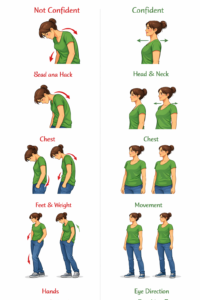 Not confident: The head tilts down or pushes forward. This creates a nervous or withdrawn impression.
- Confident: The head stays upright with the chin neutral. This shows calm presence and self-respect.
- Chest
- Not confident: The chest collapses inward, making the body look smaller and closed.
- Confident: The chest stays softly open. This signals ease, openness, and quiet strength.
- Feet & Weight
- Not confident: Weight shifts constantly or rests on one hip. The body looks unstable or restless.
- Confident: Weight is balanced on both feet. The body looks grounded and steady.
- Hands
- Not confident: Hands hide in pockets, clench, or cross. This suggests discomfort or self-protection.
- Confident: Hands remain visible and relaxed. This communicates safety, trust, and confidence.
- Movement
- Not confident: Movements are rushed, small, or jerky. The body appears anxious or unsure.
- Confident: Movements are slower and intentional. The body appears calm and in control.
- Eye Direction
- Not confident: Eyes often look down or away. This can signal insecurity or fear of judgment.
- Confident: Eyes stay at a natural, level gaze. This shows presence and self-assurance.
Scientific perspective
Posture and Emotional State
A study on posture confirms how body posture is connected to mood and cognitive performance. Sarah Awad, Tobias Debatin, Albert Ziegler, Embodiment: I sat, I felt, I performed – Posture effects on mood and cognitive performance.